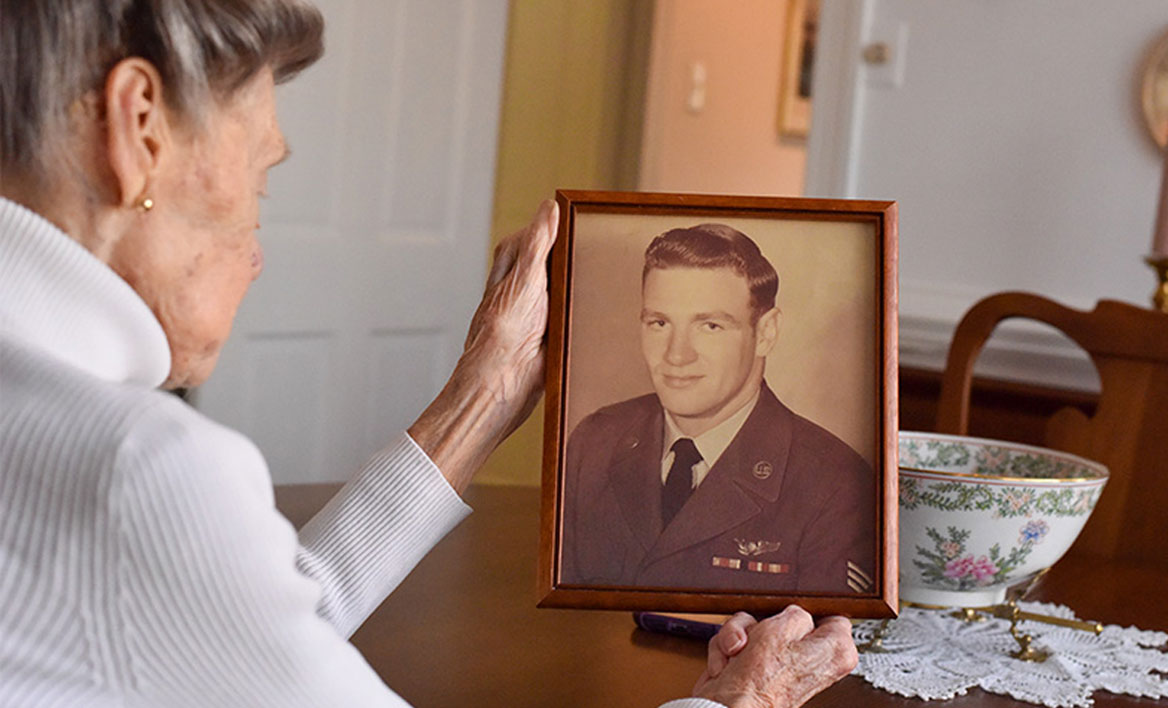
New scholarship honors veteran alumnus Jack E. Mackey
By Megan Nash
In February 1955, a few months after leaving the Air Force, Jack E. Mackey (B.S.’58) sat down in an English class at Richmond Professional Institute, now Virginia Commonwealth University, and wrote down why he had decided to go to college.
“During my four years with the Air Force, I realized my education was inadequate for my ambition,” he wrote.
More than 70 years later, that line — and the rest of his essay — has resurfaced in the paperwork behind a new scholarship being established at VCU in Mackey’s name. The fund, created by his wife, Peggy Mackey, will support veterans pursuing degrees at the VCU School of Business.
The idea did not begin as a carefully mapped-out plan. Early in their marriage, Peggy sayssa, her husband told her he hoped they would one day be able to leave money to the university. Creating the scholarship, she says, was her way of honoring that wish — and the climb she watched him make after the military: starting over in a classroom and doing the work to stay there.
In her telling, Mackey’s path to college was not polished or predictable. He grew up in Richmond’s Fan District, and in high school he cared more about football than academics. He had four close friends, and all four enlisted in the military on the same day after graduation.
“He was the only one who went into the Air Force,” Peggy says. “The others went into the Navy and the Army.” When they returned home, all four enrolled at RPI.
Peggy didn’t meet Mackey until he was already in college, and by then he was widely known as “Mackey,” his last name used so often it became the default. She remembered how tightly his days were packed as he balanced work and classes, and how determined he was to finish. At times, he worked two jobs while taking courses during the day. He went through summer and fall semesters until he was done.
“I know how hard he struggled to get his education,” she says.
Mackey’s essay shows when that determination began to harden into a plan. Serving as a flight engineer in Europe, he wrote that he flew on diplomatic missions into what he called “communistic countries” and interacted with what he described as “reasonably important Air Force people.” In those settings, he wrote, he felt the gap between his ambition and his preparation.
“It was there I first realized I was far below their intellectual level,” he wrote. “It was also in Europe that I decided a college education was essential in preparing myself for the future.”
He framed college as a direct response to that realization that he wanted more than whatever came easiest. “I don’t like to feel below average in anything,” he wrote. “My ambition is to be good, if not outstanding, in everything I do.” He also listed what he wanted from school in plain terms, including stronger writing skills and a better understanding of economics and business. “I feel I am literally grasping for any knowledge I may obtain,” he wrote.
Mackey graduated from RPI in 1958 with a bachelor’s degree in business administration.
After college, Mackey worked at Ford Motor Co. in an early data processing role tied to dealership records, but Peggy remembers him less for the job title than for what came after. The economy was rough when he finished school, she says, and he didn’t land the job right away. He graduated in June and didn’t get hired until September. “He could have gotten banking jobs,” she says, “but he didn’t want to be a banker.”
Work paid the bills, but learning stayed at the center of his life. “After he finished school, he took creative writing classes at night and some other classes,” she says. “He would have been a professional student if he hadn’t had to make a living.”
Peggy remembers Mackey’s curiosity reaching well beyond business, and it kept pulling him back to books. “He researched astrology and all the religions of the world,” she says. “And he just loved going to the library.” Once, she recalled, he invited her to go with him. “He said, ‘Wouldn’t you like to go to the library with me? It’s so much fun to read some of this,’” she says. “I said, ‘No.’ He said, ‘Well, why?’ I said, ‘Because you’ll tell me about it.”
Next to his love of learning, Mackey wrote short stories and kept papers with professors’ comments. Some pages, Peggy says, were typed on the back of Ford paper, a detail that still makes her laugh. He wrote bits and blurbs about friends, too, and he sent out some work beyond his own desk, including a few short stories he submitted to Esquire.
Peggy has kept the stories and the professor notes. But when she talks about the scholarship, she is focused on making college possible for someone else.
When asked about why she established the scholarship, Peggy comes back to one thing: access. She wants to make it easier for a veteran without the funds to get an education at VCU, and hopes the scholarship keeps the focus on the part of Mackey’s story that matters most to her: The decision to pursue an education.
“I want this to be about him and motivating other people to want to get an education as much as he did.”