Summer '11 E-newsletter
|
|
Summer '11 E-newsletter
|
|
Research and Education Highlights
Looking Forward
|
|||||||||||||||||||||||||||||||||||||
25th anniversary of the Prothonotary Warbler Project at VCU
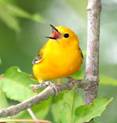
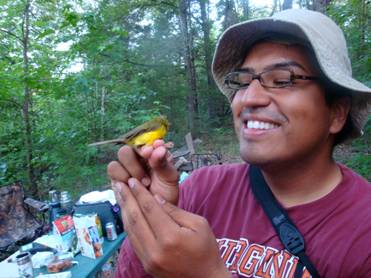
Once known as the Golden Swamp Warbler because of its striking yellow color and preference for flooded forests, the Prothonotary Warbler (Protonotaria citrea) is a Neotropical migrant songbird that breeds throughout eastern North America. The Prothonotary Warbler is the only Eastern warbler that nests in natural cavities, usually abandoned woodpeckers holes, and the availability of suitable nesting sites is a critical habitat requirement. The other critical habitat feature is water. Prothonotary Warblers prefer lowland forests near standing water for nesting sites and primarily nest along tidal portions of Chesapeake Bay tributaries in Virginia. The Prothonotary Warbler is representative of Neotropical migrant songbirds throughout the U.S., many of which are experiencing population declines. Currently, Prothonotary Warbler populations have declined over large portions of the historic breeding range in the United States in response to destruction of mangrove forests on the nonbreeding grounds and degradation and conversion of lowland forests and associated wetlands on breeding grounds. The Prothonotary Warbler spends the winter in wet lowland woods and mangrove forests throughout southern Central America and northern South America. Its breeding range extends northward from Florida, Alabama, Louisiana, Mississippi and eastern Texas to southern Michigan and Wisconsin and rarely southeastern Canada. Click here for more information. PRIMARY RESEARCHERS
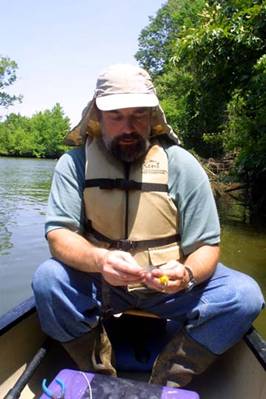
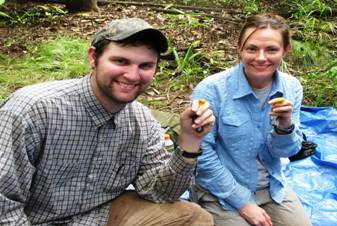
2011 marks the 25th year of longterm studies of the Prothonotary Warbler in the lower James River catchment basin. This long-term research and monitoring project was established in 1987 by now retired VCU faculty members Charles and Leann Blem. VCU researchers, graduate students and volunteers developed and modified nest boxes to maximize their use by Prothonotary Warblers and have installed and maintain over 600 nest boxes within appropriate habitat in the tidal freshwater region of the James River. Since the project began more than 26,000 Prothonotary Warblers have been raised in the nest boxes, and according to a Virginia Department of Game & Inland Fisheries website "most states in the US are recording decreases in prothonotary populations, while Virginia's population has been steady or increasing, possibly due to an aggressive nest box program." More than 100 undergraduates, graduate students, and faculty members from VCU and collaborating colleges and universities and citizen scientists including members of the Richmond Audubon Society, have participated in the research. The results of that work have received national attention and have contributed to the recent designation of the Lower James River Wetlands as an Audubon Important Bird Area (IBA). Current research projects are focused on population ecology and genetics, migration ecology, plumage and song characteristics, and conservation medicine. In 2010-2011 Team Warbler partnered with National Audubon's International Alliances Program and Panama Audubon Society in a project linking communities - both human and ecological - from "Panama Bay to Chesapeake Bay and Back." SELECTED STUDIES Effects of climate change on long-term reproductive timing and success in Prothonotary Warblers Jonathan Moore's research examines the influence of climate change on the long-term patterns (24 years) in reproductive behavior of the Prothonotary Warbler (Protonotaria citrea). Specifically, he is interested in how environmental cues potentially used for the timing of breeding by this species might explain its long-term patterns in reproductive timing. While P. citrea appears to be arriving at its breeding grounds earlier, the dates at which it lays its eggs have not also advanced, suggesting that the cue they use to time breeding is also not advancing. Environmental cues examined specific to the breeding grounds included breeding temperatures, the annual budburst or start of season (SOS), and caterpillar emergence. Global environmental cues included indices of the North Atlantic Oscillation and El Niño/Southern Oscillation. Although evidence was found that climate change is advancing many environmental cues, the study did not find a relationship between any examined environmental cue and reproductive timing. It is possible that an unexamined environmental cue may influence the non-advancing egg laying dates. Moore is also interested in how climate change may have led to mismatched breeding stages (nestling stage) of P. citrea to food peaks, and the negative impacts on reproductive success. Both caterpillar emergence patterns and clutch size reductions over time provide evidence to mismatched breeding stages. He explored this further using three different food supplement experiments over three years and explored the effects of supplements on timing of reproduction and reproductive success of P. citrea. Concurrently, he is exploring how food supplements and experimentally increased clutch sizes affect reproductive success of P. citrea and how food supplements affect male aggressive behavior and testosterone levels. He found that food supplements did not affect the timing of breeding, reproductive success nor male aggression and testosterone levels; however experimentally increased clutch sizes had lower reproductive success than unmanipulated clutch sizes. While there is evidence to suggest that breeding events have become mismatched to food peaks, food may not be limiting for P. citrea and some other environmental factor might drive reductions in clutch size.
Dutch Gap Dr. Robert J. Reilly, professor of economics and affiliate professor in the Center for Environmental Studies, began working on Prothonotary Warblers with the Blems in 1995 at Presquile National Wildlife Refuge, providing expanded coverage of nesting during the second round of breeding in June and July. Dr. Reilly has since established the Prothonotary Warbler breeding site at the Dutch Gap Conservation Area, which has become one of the three primary sites for the VCU Prothonotary Project. He also oversees multiple research sites on other species across Virginia. His current Prothonotary research interests include (1) estimating the survival rate during the post-fledging period, a critical parameter in population modeling, (2) determining the correlation between post-fledging movements of juveniles and their subsequent selection of breeding sites, (3) identification of the factors contributing to transmission of avian disease on the breeding grounds, and (4) determining a longevity profile for the species.
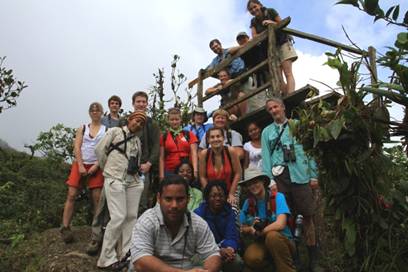
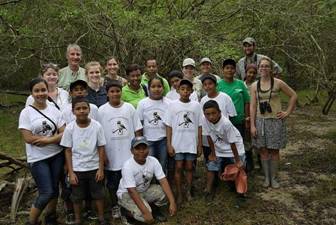
Panama and Avian Tropical Ecology Blending rigorous science and community engagement in both Panama and Richmond, faculty members Lesley Bulluck (biology and Center for Environmental Studies) and Bryan Watts (VCU Rice Center and director, Center for Conservation Biology) along with Richmond Audubon Society members Julie Kacmarcik and Peter Doherty (bird bander, Coastal Virginia Wildlife Obvservatory) led 11 VCU students on a 10-day trip to Panama in early January. The focus of the trip was to initiate a long-term monitoring program on Prothonotary Warblers in partnership with the Panama Audubon Society. Mist netting and banding of birds were conducted at three mangrove forests that differed in their age and size of the forest. Observational data on the density and foraging rates of birds also was conducted at three mudflats along the Panama coast, the mudflats differing in their distance from mangrove forests. The mist netting resulted in 160 birds of 25 different species being banded. Of these, 26 individuals were Prothonotary Warblers. Data on thousands of birds were collected at the mudflats. Statistical analyses are now being performed to determine if there are any differences in species diversity, abundance and foraging efficiency (mudflats) and body condition (mangroves). After training the VCU students on field methods, the group was split to alternate each day between banding in the mangroves and taking data on bird density and foraging rates in the mudflats. In addition, "Team Warbler" engaged students from the San Carlos school district in Panama and from Robious Middle School in Richmond in the project. These students learned about birds, migration, feathers and nest predation. The San Carlos students visited the banding station in Playa Bonita, were involved in the monitoring project and, then through a website, interacted, with the Richmond students.
PUBLICATIONS As of August 2011 the VCU Prothonotary Warbler Project has resulted in 11 publications and numerous undergraduate and graduate student studies Prothonotary Warbler Project Publications: Blem, C. R. and L. B. Blem. 1991. "Nest box selection by Prothonotary Warblers." Journal of Field Ornithology 62:299-307. Blem, C. R. and L. B. Blem. 1992. "Prothonotary Warblers nesting in nest boxes: Clutch size and timing in Virginia." The Raven 63:15-20. Blem, C. R. and L. B. Blem. 1994. "Composition and microclimate of Prothonotary Warbler nests." The Auk 111:197-200. Blem, C. R., Karen L. Rossignol and Natasha N. Bundick. 1998. "Effect of predation on clutch size in Prothonotary Warblers." Sialia 20:3-7. Blem, C. R., L. B. Blem and Lisa S. Berlinghoff. 1999. "Old Nests in Prothonotary Warbler nest boxes: effects on reproductive performance." Journal of Field Ornithology 70: 95-100. Blem, C. R., L. B. Blem and Claudia Barrientos. 2000. "Relationships of clutch size and hatching success to age of female Prothonotary Warblers." The Wilson Bulletin 111:577-581. Podlesak, D. W. and C. R. Blem. 2001. "Factors affecting growth of Prothonotary Warblers." Wilson Bulletin 113:263-272. Podlesak, D. W. and C. R. Blem. 2002. "Determination of age of nestling Prothonotary Warblers." Journal of Field Ornithology 73:33-37. Blem, C. R. and L. B. Blem. 2006. "Variation in mass of female Prothonotary Warblers during nesting." The Wilson Journal of Ornithology 118: 3-12. Clarkson, C.E. 2007. "Food supplementation, territory establishment, and song in the Prothonotary Warbler." The Wilson Journal of Ornithology 119: 342-349. Grillo, E.L., R.C. Fithian, H.Cross, C. Wallace, C. Viverette, Robert Reilly and D.C.G. Mayer. "Presence of Plasmodium and Haemoproteus in breeding Prothonotary warblers (Protonotaria citrea: Parulidae): Temporal and spatial trends in infection prevalence." Journal of Parasitology. In press Recent Graduate Student Theses: Viel, D.M. 2007. "Post-fledging survival in a Neotropical migrant, The Prothonotary Warbler (Protonotaria citrea): A large-sample mark-recapture study." M.S. Thesis, Virginia Commonwealth University, Richmond, VA. Grillo, Elena. 2009. "Presence of Haemosporidia and Flaviviruses in breeding Prothonotary Warblers (Protonotaria citrea): an analysis of temporal and spatial trends in infection prevalence and associations with reproductive success." M.S. Thesis, Virginia Commonwealth University, Richmond, VA. Fithian, Robert. 2009. "Honest indicators in the Prothonotary Warbler (Protonotaria citrea): the effect of pathogen infections on plumage and a through description of breast feather reflectance in adult Prothonotary Warblers." M.S. Thesis, Virginia Commonwealth University, Richmond, VA. Wallace, Katie. 2010. "Distribution and molecular analysis of vectors of avian malaria on four central Virginia Prothonotary Warbler (Protonotaria citre) breeding sites." M.S. Thesis, Virginia Commonwealth University, Richmond, VA. Riggan, Anna. 2011. "Ecological profiling of mosquito-bird interactions in Central Virginia." M.S. Thesis, Virginia Commonwealth University, Richmond, VA. Recent Undergraduate Student Projects: Duke, Morgan. 2010. Long-term study of double-brooding rates in the Prothonotary Warbler (Protonotaria citrea). Conway, Nathan. 2010. Study of reproductive success across age classes of Prothonotary Warblers (Protonotaria citrea). Khan, Nyla. 2010. Male and female feather reflectance in a Nearctic-Neotropical migratory warbler: does it communicate fitness? Byggmastar. 2010. Female sexual selection in Protonotaria citrea: Tail spot area correlates with clutch size. Rubis, K., A. Besterman, and T. Wise. 2011. Plumage coloration of the Prothonotary Warbler (Protonotaria citrea) as an indicator of territorial dominance and seasonal variation. Studd-Sojka, Alex and Anna Tisdale. 2011. Avian quality, abundance, and diversity in Panamanian Mangroves with emphasis on the Prothonotary Warbler (Protonotaria citrea). Besterman, Alice. 2011. Estimating caterpillar abundance through frass collection to see if Prothonotary warblers (Protonotaria citrea) feed caterpillars to nestlings in proportion to their availability. Schablein, Laurel. 2011. Quantifying the proportion of aquatic and terrestrial food items delivered to Prothonotary Warbler (Protonotaria citrea) nestlings. |
|||||||||||||||||||||||||||||||||||||
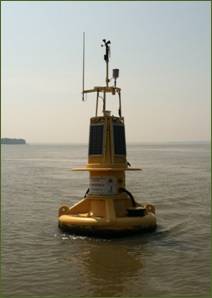
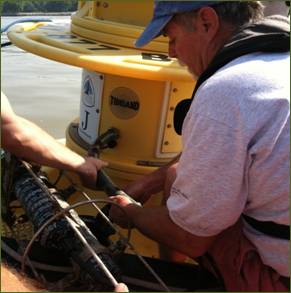
You have e-mail - from Atlantic sturgeonThrough our Rivers in Real-Time: Migration! Grant from the National Oceanographic and Atmospheric Administration (NOAA), prototypes of two different VEMCO global satellite receivers have been deployed in the James River and are collecting data from Atlantic sturgeon outfitted with acoustic transmitter tags. One receiver, just downstream of the VCU Rice Center, is the first of its kind to be deployed on the East Coast of North America. The second receiver, the first deployed anywhere in the world, has been placed on an observational buoy at Jamestown, part of NOAA's Chesapeake Bay Interpretive Buoy System.
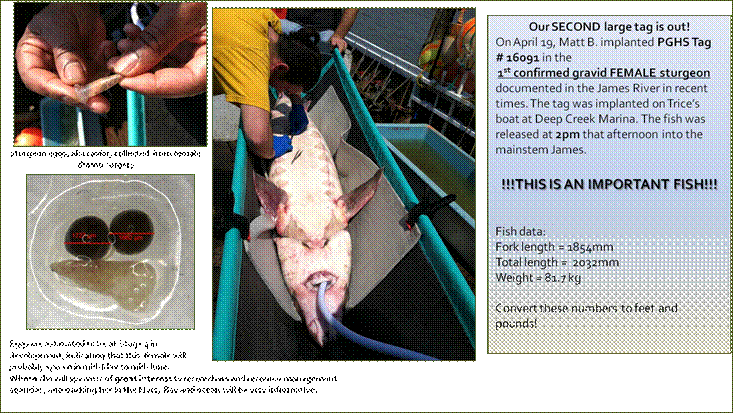
The CBIBS buoys are located throughout the Chesapeake Bay and collect and transmit real-time environmental data that is made available to the public. NOAA plans to add satellite receivers to additional CBIBS buoys so that researchers and interested parties can track sturgeon and other tagged fish in real time throughout the Bay. The way it works: A transmitter is activated and continuously emits an acoustic signal or "ping" containing time, location, water depth and other information. The tag is surgically implanted into a fish, and the fish is released back into the river. If the fish swims within range of a receiver (~1/2 mile), the receiver detects the transmitter ping, stores the data, transmits it almost instantaneously via email to addresses on a "watch list", and you’ve got e-mail from a sturgeon!!! At present, Prince George High School, VCU Environmental Outreach, NOAA, and USFWS are on the email list. During April and May 2011, the lower James River was a hotbed of sturgeon activity. Seven acoustic transmitters owned by Prince George High School were implanted into sturgeon by VCU doctoral student Matt Balazik. Students at PGHS have been collecting environmental data all year and are now correlating the data to sturgeon movements in the James River and the Bay. Below is an excerpt from the STURGEON NEWS on a female sturgeon implanted with a PGHS transmitter in April. 2012 should be an exciting year for our students to watch these fish move about in the James River and Bay!
Click here for more information on the project. Many thanks to Dr. Doug Wilson (NOAA), sturgeon surgeon Matt Balazik (VCU Ph.D. candidate), Albert Spells (USFWS Project Leader for the Virginia Fisheries Coordinator Office) and George Trice and Jimmie Moore, commercial fishermen in the Newport News area. The work by Spells/Trice/Moore is funded by a Fisheries Resource Grant through the Virginia Sea Grant at VIMS. |
|||||||||||||||||||||||||||||||||||||
Protecting our Pools of KnowledgeVernal pools are small, temporary pools of water that act as vital breeding grounds for mole salamanders, including the marbled salamander and the spotted salamander. Adult salamanders spend most of their life in the forest surrounding the vernal pools, migrating to vernal pools for reproduction. It is vital that the young salamanders, coined as "vernal pool obligate species," develop in fishless, predator-free pools. Because each mole salamander tends to reproduce in the pool in which it was born, protecting a single pool is vital to the salamander families that return each year.
Led by Anne Wright, Holly Houtz and James Vonesh, 80 volunteers from the Virginia Master Naturalist Program and researchers from VCU and the College of William and Mary worked to characterize the decline of vernal pools in Virginia. In the 1980s, Charles Blem, Ph.D., then a professor in VCU's Department of Biology, collected information on locations of vernal pools and salamander presence in 17 counties surrounding Richmond. This past spring, the master naturalists and researchers visited 185 of the designated vernal pools. Of the pools for which presence could be determined, the group found that more than 35 percent of the vernal pools had been destroyed. So far, our studies show that the predominant causes of habitat destruction are road work/ditching, construction and farming. State law protects some vernal pools, but regulations are rarely enforced. Since public awareness of this unique wetland habitat is limited, the pools and associated forests in Virginia face substantial threats.
In more uplifting news, almost 100 pools of the original sample are still present, and the master naturalist group had the first official identification of the presence of marbled salamanders in Dinwiddie County! Click here for more information on the project. |
|||||||||||||||||||||||||||||||||||||
Anuran night out!
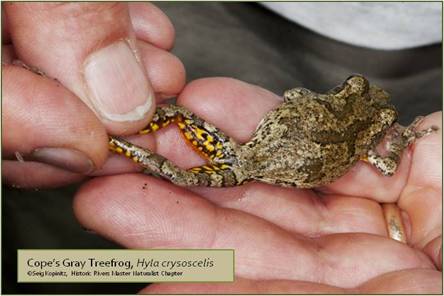
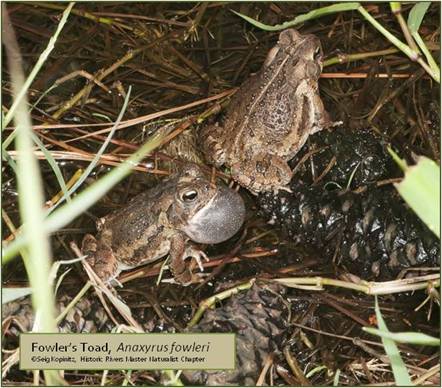
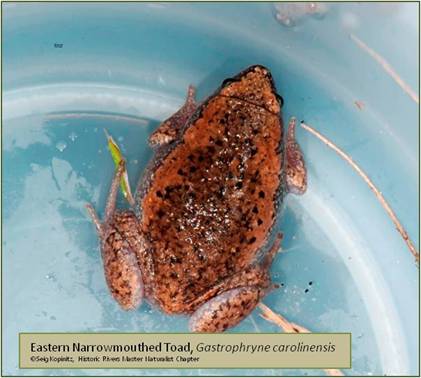
Over two steamy summer nights, 68 amphibian enthusiasts hunted frogs and toads at the VCU Rice Center and USFWS Harrison Lake National Fish Hatchery. Members from three master naturalist chapters, USFWS interns, VCU students and assorted family and friends joined Dr. Lou Verner (Virginia Department of Game and Inland Fisheries) and Outreach Coordinator Anne Wright to learn how to identify our local anuran fauna. Verner reviewed the identifying characteristics and calls of Coastal Plain species using "The Calls of Virginia Frogs and Toads" CD. This is an excellent VDGIF resource for anyone wanting to identify Virginia fauna by ear.
Thanks to several children in the group, many frogs and toads were caught, and everyone had a close up look at the identifying characteristics of many species. Black lights set up at the Rice Center brought in lots of insects and toads for photographing, and the local Barred owls put on a raucous late night show for those who stayed up late. Species list for the 2 sites
|
|||||||||||||||||||||||||||||||||||||
Photographs by Master Naturalist Seig Kopinitz
|
|||||||||||||||||||||||||||||||||||||
|
|||||||||||||||||||||||||||||||||||||
|
|||||||||||||||||||||||||||||||||||||
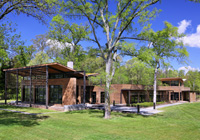
VCU Rice Center receives Governor's Silver Award for ExcellenceThe Walter L. Rice Education Building at the VCU Rice Center won a Silver Award in the Environmental Projects category of this year's Governor's Environmental Excellence Awards, presented at the Environment Virginia Symposium in Lexington, VA. The award recognized the many sustainability features of the building and its LEED Platinum certification.
|
|||||||||||||||||||||||||||||||||||||
Third Annual VCU Rice Center Research SymposiumOn May 6, 2011, the VCU Rice Center hosted its Third Annual Research Symposium, an event that brought together more than 70 VCU faculty, students and researchers from cooperating universities, agencies and organizations to share research projects. The day-long event included exciting new research findings in both oral and poster presentations. Oral presentation sessions included river ecology, wetland ecology, and plant and vertebrate ecology.Click here for Symposium agenda. |
|||||||||||||||||||||||||||||||||||||
Looking Forward |
|||||||||||||||||||||||||||||||||||||
Come to an Open House at the VCU Rice Center
Come walk the site overlooking the historic James River and learn about the many research activities underway - just some of which include one of the largest wetland restoration projects on the East Coast and the Atlantic Sturgeon Restoration activities. The Center conducts informal tours every second Thursday of the month from 1.00 p.m. to 4.00 p.m. Click here for directions. | |||||||||||||||||||||||||||||||||||||
Third Sturgeon reef scheduled to be constructed by year-endVCU will partner with The Nature Conservancy, NOAA, Luckstone Corporation, and JRA to construct a third artificial spawning reef in the James River for Atlantic sturgeon. The iconic sturgeon--currently proposed for listing under the Endangered Species Act--requires hard-bottom substrate for successful spawning. However, most of the historic habitat in the James has been lost to habitat alternation and sedimentation. A similar consortium built sturgeon spawning reefs in 2010 and 2011 near Turkey Island and Jones Neck. Vulcan Materials and the FishAmerica Foundation were key partners in those earlier efforts. On-going monitoring of the tidal James River by Rice Center biologists has provided evidence of sturgeon spawning activity in the vicinity of enhanced habitat. Click here for more information on this project. |
|||||||||||||||||||||||||||||||||||||
Ribbon Cutting Ceremony for the Wetlands and Stream Restoration ProjectIn conjunction with the Virginia Aquatic Resources Trust Fund and The Nature Conservancy, approximately 200 feet of the earthen dam on Kimages creek built to create Lake Charles has been deconstructed along with the removal of the spillway in order to allow the free flow of Kimages Creek into the James River and the restoration of approximately 70 acres to its natural wetland state. On September 28th, Governor McDonald along with officials from all participating governmental agencies and non-profit organizations will attend a ribbon cutting ceremony at the VCU Rice Center. Click here for more information.
|
|||||||||||||||||||||||||||||||||||||
Virginia Commonwealth University | VCU Rice Center |
|||||||||||||||||||||||||||||||||||||
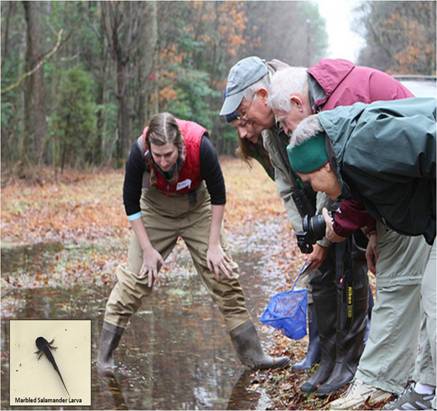 During their training, Master Naturalists
investigated the presence of mole salamander larvae in the vernal pools at
VCU's Rice Center.
During their training, Master Naturalists
investigated the presence of mole salamander larvae in the vernal pools at
VCU's Rice Center.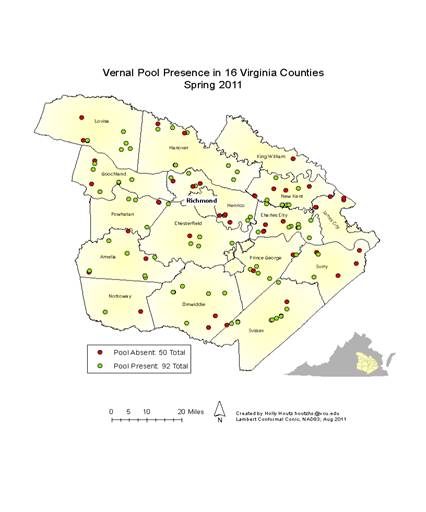 Map
displaying site locations and current presence or absence of vernal pools
identified by Blem in the 1980's. About 50 additional pools require ongoing investigation to finalize presence and absence.
Map
displaying site locations and current presence or absence of vernal pools
identified by Blem in the 1980's. About 50 additional pools require ongoing investigation to finalize presence and absence.

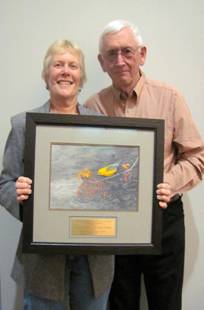
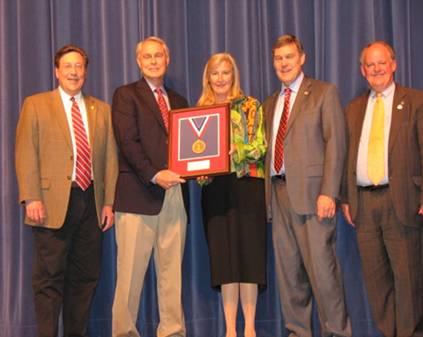 Dr. Len Smock and Catherine Dahl of the VCU Rice Center receive the Governor's Award for Excellence, presented by the Honorable Douglas Domenech, Virginia Secretary of Natural Resources, David Paylor, Director, Virginia Department of Environmental Quality, and David Johnson, Director, Virginia Department of Conservation and Recreation.